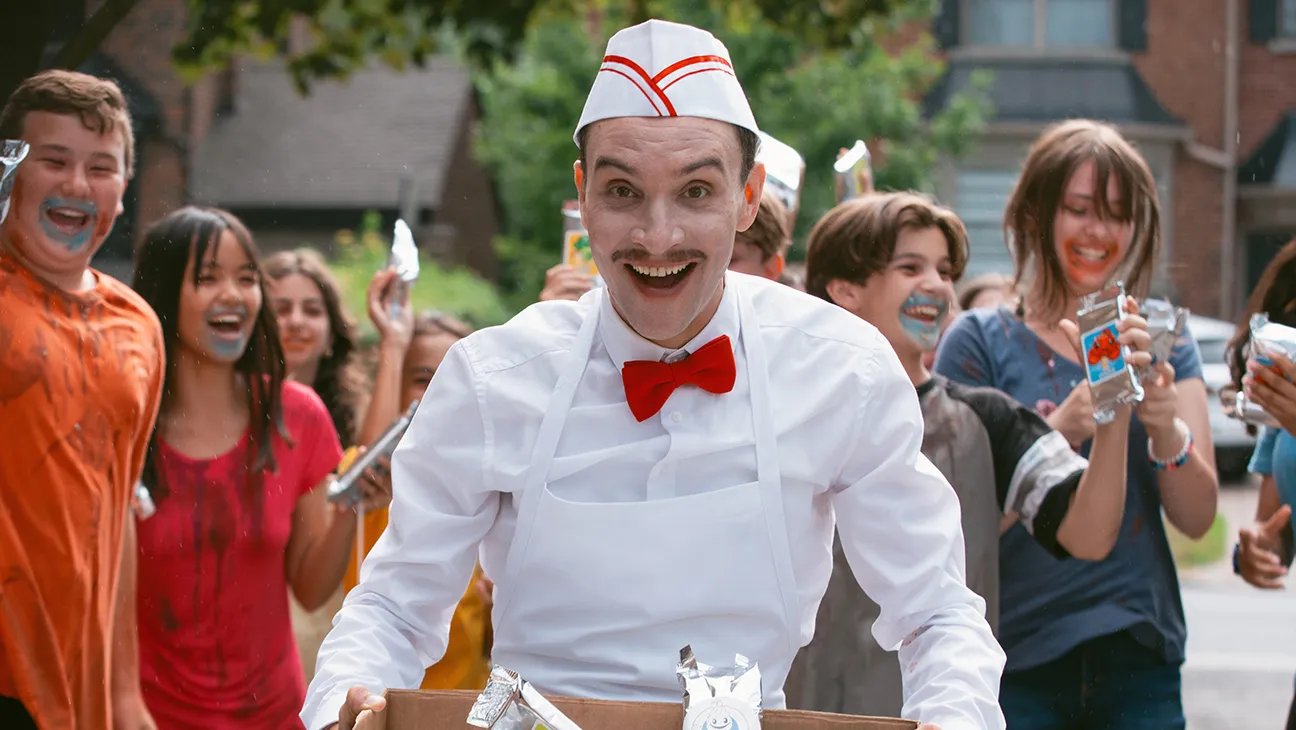
Lance Oppenheim has spent much of his career blurring the line between documentary and fiction, and Primetime feels like the logical culmination of that fascination. Set within the strange, fading world of local television, the film follows a small crew attempting to manufacture entertainment while chasing ratings, relevance and validation.
At the heart of the story is To Catch a Predator host Chris Hanson (Robert Pattinson), a local television personality whose dream is to be number one. The film drops us directly into a crucial period of his life and career, following him as he navigates the pressures of producing television while desperately maintaining the image he has built around himself. Orbiting Hanson are a group of colleagues and collaborators, including his long-suffering producer Andie Bender (Merrit Weaver). As the pursuit of ratings intensifies, so too does the tension between the people involved, revealing the human cost of chasing success in a shrinking corner of the entertainment industry.
One of the film’s greatest strengths is its visual style. Oppenheim approaches the material with a documentarian’s eye, creating a world that often feels less like a scripted drama than a recovered piece of media history. The aesthetic recalls a worn VHS tape from the 1990s, with washed-out images that evoke the half-remembered broadcasts of local television’s heyday. This texture gives the film a distinctive personality, but it also serves a thematic purpose, reinforcing the sense that Hanson is clinging to a version of fame that is already disappearing.
The cinematography is surprisingly expressive throughout. Oppenheim repeatedly pushes his camera close to faces, particularly Pattinson’s, creating moments that feel almost horror-like in their intensity. Extreme close-ups capture every bead of sweat, every flicker of insecurity and every hollow eyed stare. Combined with the film’s colour palette of Florida pinks, swimming-pool teals and shadowy greys, these images create a dreamlike atmosphere that sits somewhere between nostalgia and nightmare. It is an unusual visual approach for a story about local television, but it works remarkably well.

Much of the film’s success rests on Robert Pattinson’s shoulders, and he delivers what may well be one of the finest performances of his career. Pattinson is operating on an entirely different plane to everyone around him, fully inhabiting Hanson as a man driven by equal parts confidence, delusion and hunger. Hanson believes he deserves everything he wants. (If not the world, then at the very least the number one spot in the ratings.) Pattinson captures that mindset in every line delivery and every physical gesture. He plays Hanson as perpetually on the verge of either triumph or collapse, radiating a sweaty, wide-eyed intensity that makes him impossible to ignore.
What is most impressive is how Pattinson never allows Hanson to become a caricature. It would have been easy to portray him purely as an outright villain, but the performance finds traces of vulnerability beneath the ego. Even when Hanson is behaving terribly, Pattinson ensures we understand the insecurities driving his actions. The result is a character who is often frustrating, occasionally appalling, but always compelling.
Skyler Gisondo provides excellent support as Dan Plum. If Hanson is the predator at the centre of the ecosystem, Dan frequently feels like its prey. The film’s most uncomfortable moments often involve his character, whose optimism is slowly eroded by the realities of the television world he has entered. His emotional reaction while filming his first episode is genuinely moving – it is a deeply shocking encounter with a predatory guest, played in a startling cameo by former child star Jonathan Lipnicki.
The dynamic between Dan and Hanson is particularly effective. Hanson seeks to secure Dan’s loyalty through small acts of generosity, buying meals, supplying beer and offering flattering encouragement. Yet these gestures never feel entirely altruistic. Instead, they function as subtle tools of manipulation, making their relationship increasingly uncomfortable as the film progresses. Gisondo plays this growing unease beautifully, creating a character whose gradual understanding of the situation becomes one of the film’s strongest emotional threads.

Merritt Wever is equally impressive as producer Andie Bender. Constantly chewing huge wads of gum, Andie spends much of the film caught between competing demands. Hanson routinely undervalues and mistreats her despite relying heavily on her work, and the frustration of this situation leaks into her interactions with those beneath her. Wever captures this cycle of workplace resentment with remarkable precision. Her performance is subtle but crucial, highlighting how toxic environments often reproduce themselves through people who feel powerless within them.
Narratively, Primetime is tight, focused and consistently engaging. The script wastes little time, plunging viewers straight into its central conflict and maintaining momentum throughout. Yet that efficiency can occasionally feel limiting. The film offers very little context about what came before this chapter in Hanson’s life or what follows it, making parts of the story feel somewhat abbreviated. A deeper exploration of the wider circumstances could have added additional weight to the drama.
Even so, whilst Primetime may not explore its characters quite as deeply as it could, its unique atmosphere and fascinating central figure make it well worth watching.
Primetime is in UK cinemas.

- Primetime – Review - November 11, 2026
- The Devils 4K Re-Release – Review - November 2, 2026
- I Love Boosters – Review from London Film Festival - October 16, 2026