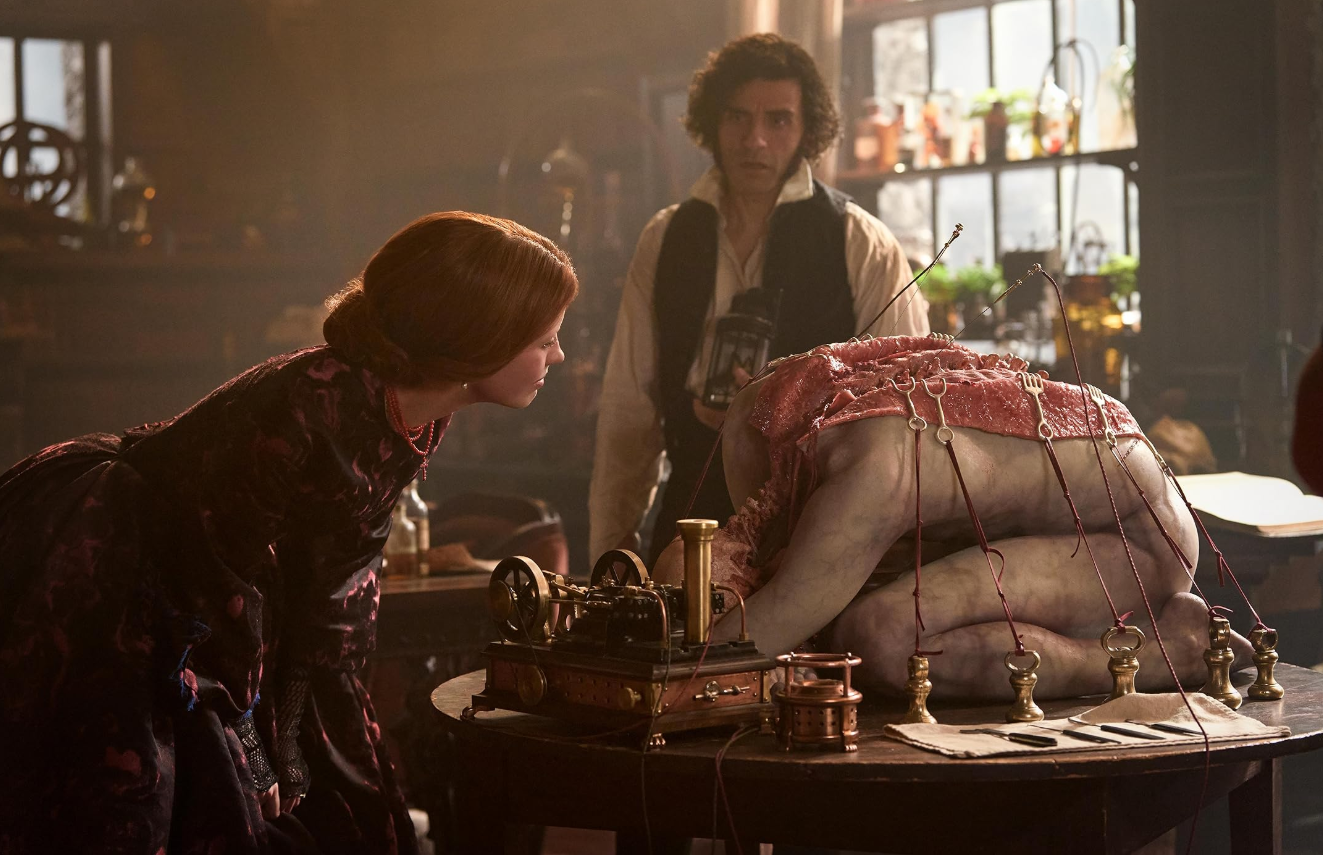
“It’s alive! It’s alive!” is surely one of the most famous cries in all of cinema. And whilst Guillermo del Toro’s Frankenstein doesn’t give us a repeat of this refrain, it certainly revels in all the drama, horror, and philosophical weight of Mary Shelley’s cautionary tale. Del Toro’s long-awaited adaptation is a gothic epic, a visual and emotional feast that reimagines the classic story with a fresh, tragic lens.
Del Toro’s Frankenstein opens in the icy Arctic, where a Danish naval crew led by Captain Anderson (Lars Mikkelsen) stumbles upon a half-dead Victor Frankenstein (Oscar Isaac), pursued by a towering, anguished Creature (Jacob Elordi). From this chilling prologue, the film unfolds in three acts: Victor’s tale, the Creature’s awakening, and their final confrontation.
Victor’s story is one of obsession and grief. Haunted by the death of his mother Claire, he grows into a brilliant but arrogant surgeon in London, determined to conquer death itself. His experiments, deemed grotesque and blasphemous, catch the attention of Harlander (Christoph Waltz), a wealthy arms dealer who offers Victor the resources to pursue his darkest ambitions. With the help of Harlander’s niece Elizabeth (Mia Goth), Victor assembles a being from the remains of fallen soldiers and prisoners. The result is the Creature, a patchwork man born into pain and rejection.

Oscar Isaac struts through the film in green silk, white flounce shirts and red leather gloves, embodying Victor Frankenstein with rakish arrogance and manic intensity. His Victor is not just a scientist, but a man consumed by grief and ego, teetering on the edge of madness. Isaac’s performance is layered: at times charming, often cruel, and ultimately pitiable.
Mia Goth is resplendent in tulle and silk, her enormous underskirts sweeping through candlelit corridors. As Elizabeth, she offers tenderness and insight, seeing through Victor’s ambition to the broken boy beneath.
Christoph Waltz brings a chilling calm to Harlander, a man whose genteel exterior masks a sinister desire to manipulate life and death. Felix Kammerer, as Victor’s brother William, adds youthful innocence to the tale, while Charles Dance’s Leopold Frankenstein leaves violent, brutish footprints for his son to follow.
But it is Jacob Elordi who steals the film. His Creature is a revelation – physically imposing yet heartbreakingly gentle. From the moment he opens his eyes, they brim with sadness and longing. Elordi’s performance is deeply physical, channelling the spirit of Bernie Wrightson’s illustrations. It is a career-defining role, transforming Elordi from heartthrob to tragic icon.
The second half of the film shifts to the Creature’s perspective. Elordi’s monster is no mindless brute; he is intelligent, sensitive, and desperate for connection. As he learns language and grapples with his identity, he seeks love from his creator. When denied, turns to rage.

Del Toro’s insistence on practical sets pays off spectacularly. Victor’s laboratory, built inside an abandoned Scottish water tower, is a marvel of gothic architecture: marble floors, spiral staircases and an enormous circular window that floods the room with light. The motif of circles, perhaps representing the ouroboros and the cycle of life, recurs throughout the film.
The film’s visual palette evokes Anster Fitzgerald paintings: rich, dark, and romantic. Labs bubble and froth with electricity; windows are ornate; caskets are carved with angelic figures. The birth of the Creature is visceral and unforgettable: body parts slop across the floor, blood spatters Victor’s ankles, and as Elordi breathes his first, the camera plunges into his nervous system, veins and arteries swirling across the screen.
Alexandre Desplat’s score is searing and sentimental, a fairytale symphony that underscores the film’s emotional core. It swells with romance, trembles with dread and aches with empathy. It’s a perfect match for del Toro’s high melodrama.
Del Toro’s Frankenstein is rich with thematic depth, weaving together ideas of creation, identity, and the consequences of unchecked ambition. At its core, the film explores the tension between gods and monsters: Victor’s attempt to play God inevitably leads to ruin, echoing Mary Shelley’s original warning about the dangers of hubris. The Creature’s very existence raises profound questions about the right to life and the ethical responsibilities of a creator toward their creation. Loneliness permeates the narrative, especially through the Creature’s heartbreaking plea for companionship, which becomes the emotional anchor of the story. Del Toro also delves into the nature of empathy and what it truly means to be human, challenging the audience to reconsider who the real monster is: the abandoned, suffering Creature or the man who brought him into the world only to reject him. Finally, the film examines the destructive nature of legacy and ambition, as Victor inherits his father’s cruelty and perpetuates a cycle of pain, blinded by his desire to transcend mortality.

These themes are explored with nuance and passion, making the film not just a horror story, but a philosophical meditation on creation, rejection, and the human condition.
Guillermo del Toro’s Frankenstein is a triumph of gothic cinema. It is grotesque and gorgeous, brutal and tender. With stunning performances, handcrafted sets, and a score that sings with sorrow, the film breathes new life into Shelley’s timeless tale. It doesn’t shout “It’s alive!” like its predecessor, it whispers it; mournfully, beautifully and with profound humanity.
Frankenstein screened at the London Film Festival 2025 and will be in UK cinemas on October 17, before transferring to Netflix on November 7.

- Pressure – Review - September 12, 2026
- Backrooms – Review - May 31, 2026
- Obsession – Review - May 25, 2026