It has often been said that British people love to talk about the weather. It dictates what we wear, how we travel, the plans we make and, on occasion, even our mood. As conversational topics go, it can seem fairly mundane. Yet in June 1944, weather forecasts became one of the most critical pieces of information in human history. The success or failure of the Allied invasion of Normandy rested not only on military strategy and manpower, but on whether the skies would clear and the seas would calm.
In Anthony Maras’ Pressure, based on David Haig’s acclaimed stage play first performed at Edinburgh’s Royal Lyceum Theatre, that extraordinary true story is brought to the screen with intelligence, suspense and emotional weight.
Andrew Scott stars as Group Captain James Stagg, the Chief Meteorological Officer tasked with advising Supreme Allied Commander Dwight D. Eisenhower in the days leading up to D-Day. Summoned to the nerve centre of Allied operations in Britain, Stagg finds himself under immense pressure as military leaders demand certainty from an inherently uncertain science. Every forecast he produces could determine the fate of thousands of soldiers and potentially alter the course of the Second World War itself.
What follows is essentially a war thriller in which the enemy is not only the German army but the unpredictability of nature. On paper, that premise could make for a dry historical drama. Instead, Pressure transforms meteorological reports into compelling cinematic tension, creating nail-biting drama from weather charts, conflicting predictions and ticking clocks.
Scott is utterly mesmerising in the leading role. His Musselburgh accent never falters, even during moments of confrontation and heightened emotion, grounding the performance firmly in Stagg’s Scottish roots. Maras’ camera frequently lingers on Scott’s face, capturing every flicker of frustration and every moment of doubt hidden beneath a rigidly professional exterior. Stagg is not an easy man. His curt manner, stubborn insistence on evidence and unwillingness to indulge military egos make him deeply unpopular among many of the commanders surrounding him. Yet Scott ensures he is never unlikeable.

Importantly, the performance never falls into the trap of portraying Stagg as a stereotypical gruff Scot. Alongside his steely professionalism, we are shown a gentler side through scenes depicting his family life and his devotion to the scientific work he believes can save lives. Scott communicates enormous amounts through the smallest gestures. A narrowed glance, a clenched jaw or a momentary twitch around the eyes reveal the burden of responsibility weighing upon him. It is one of those quietly commanding performances that becomes more impressive the longer the film goes on.
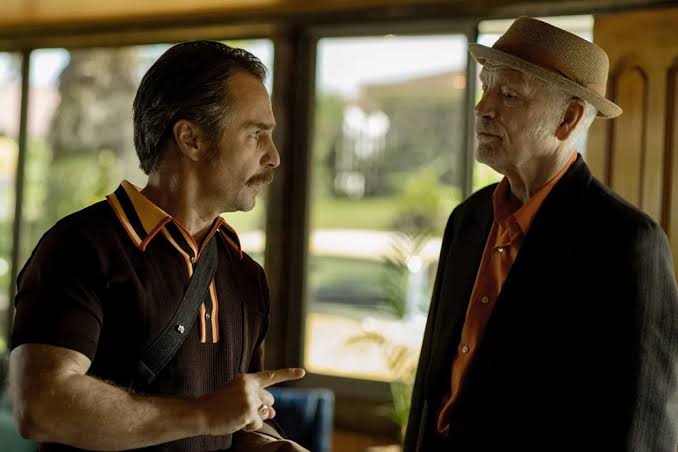
His most compelling scenes come opposite Chris Messina’s Irving Krick, the confident American meteorologist whose forecasting methods sharply contrast with Stagg’s rigorous reliance on data. Messina plays Krick with considerable swagger and charisma, presenting a man whose certainty threatens to overshadow Stagg’s caution. Their clashes form the dramatic backbone of the film, embodying the conflict between intuition and evidence, confidence and caution. The pair generate a fascinating onscreen rivalry that elevates every meeting room debate into something approaching a duel.
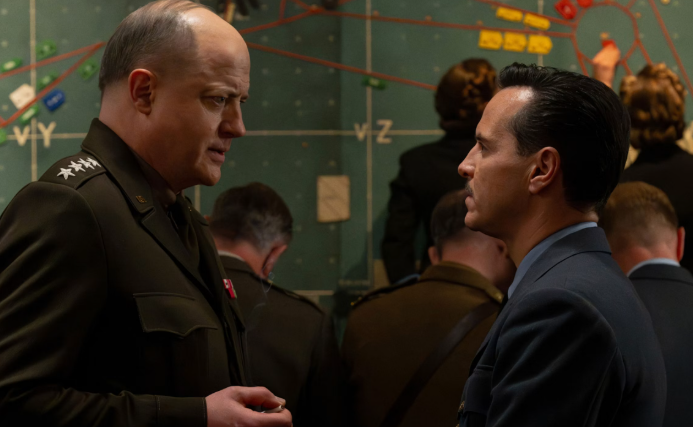
Brendan Fraser brings tremendous authority to the role of Eisenhower. His physical presence alone commands attention, standing rigid and imposing amongst his subordinates. Fraser’s Eisenhower is haunted by the memory of previous military exercises that ended in tragedy and understands all too well the catastrophic consequences of failure. Every decision he makes carries unimaginable weight. The actor captures both the public confidence required of a wartime leader and the private anxiety of a man who knows countless lives depend on his judgement. His booming voice fills every room, yet Fraser also finds moments of vulnerability beneath the military composure.
Strong supporting performances abound. Kerry Condon is excellent as Kay Summersby, providing confidence, intelligence and warmth without ever becoming merely a supporting figure to the men around her. Damian Lewis enjoys himself as the famously outspoken Bernard Montgomery, delivering a larger-than-life portrayal that threatens to steal scenes whenever he appears. Meanwhile, Messina ensures Krick remains more than a simple antagonist. The result is an ensemble that feels fully realised, with even minor characters given depth through a sharp and thoughtful screenplay.
Visually, Maras demonstrates a remarkable understanding of the story’s central themes. Light and darkness become recurring motifs throughout the film. Eisenhower’s war room is deprived of natural light, forcing attention towards vast maps and strategic plans while creating an atmosphere of claustrophobic pressure. Elsewhere, the opening of shutters floods rooms with sunlight, offering brief moments of hope before gathering storm clouds plunge environments back into shadow. Weather is not merely discussed; it is constantly reflected in the film’s visual language.

The cinematography captures this beautifully. Thunderstorms darken stained-glass windows, casting ominous shadows across worried faces. Firelight flickers across anxious military planners, simultaneously creating warmth and unease. These visual choices reinforce the idea that nature itself is an active participant in the unfolding drama.
Volker Bertelmann’s score is equally effective. Having delivered the thunderous and unsettling soundtrack for All Quiet on the Western Front, he takes a more restrained approach here. The music is driven by an ever-present ticking motif that constantly reminds audiences of the narrowing window available to launch the invasion. Strings swell with melancholy and apprehension, hinting at the immense human cost behind every strategic discussion.
Despite audiences already knowing the outcome, Pressure remains gripping throughout. The inevitability of history does nothing to diminish the suspense because Maras focuses not on what happened, but on how close events came to unfolding differently. The incorporation of colourised archival footage alongside dramatic recreations of the Normandy landings serves as a powerful reminder of the real men whose lives hung in the balance while forecasters debated atmospheric conditions in a cramped room hundreds of miles away.
In turning weather reports into edge-of-your-seat drama, Pressure achieves something genuinely remarkable. Anchored by a career-best performance from Andrew Scott and supported by a superb ensemble, it is an intelligent, moving and unexpectedly thrilling examination of one of history’s most consequential decisions. It proves that sometimes the smallest variables can have the greatest impact, and that talking about the weather really can change the world.
Pressure is now in UK cinemas.

- Pressure – Review - September 12, 2026
- Backrooms – Review - May 31, 2026
- Obsession – Review - May 25, 2026