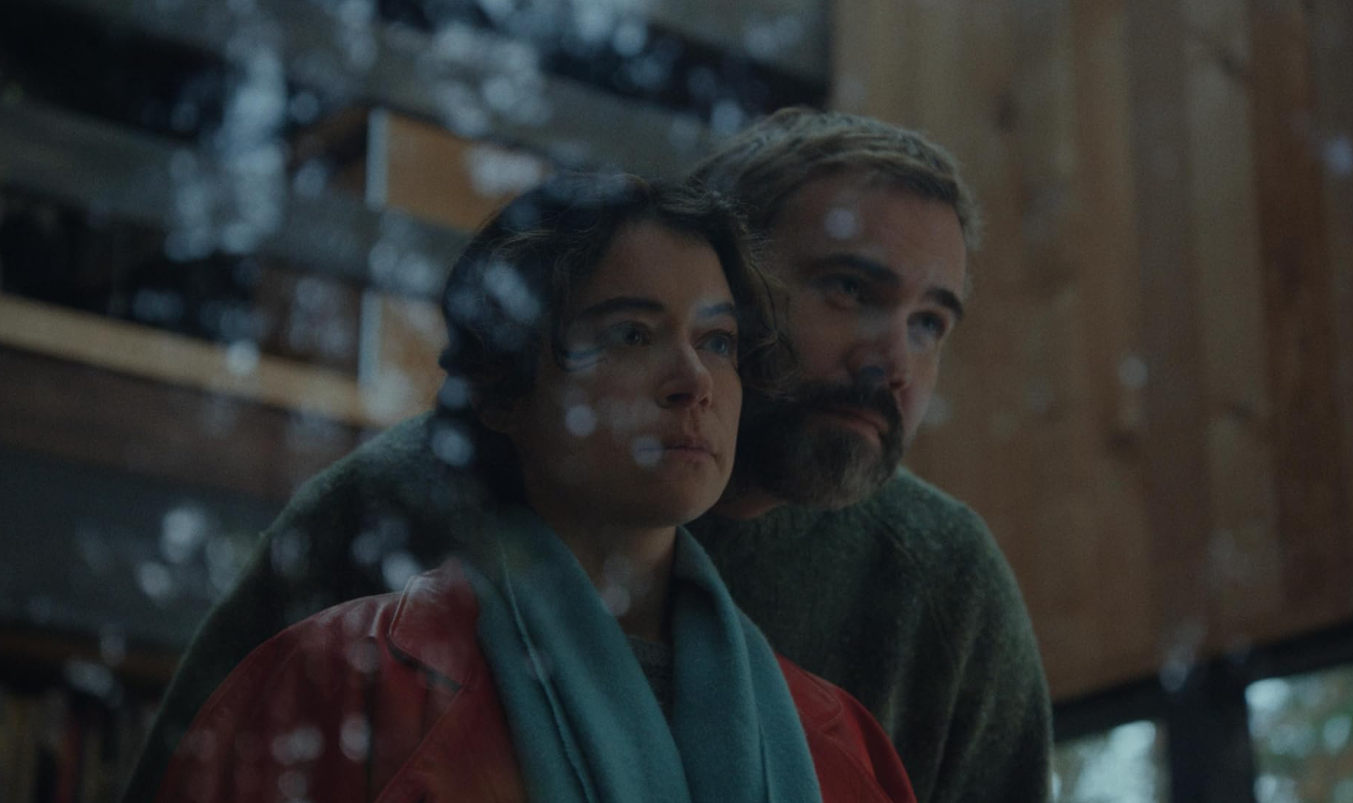
Osgood Perkins has long established himself as the “weird kid” of horror cinema. He likes to play around with conventional fears and bring you new ones you never knew you needed. He continues these efforts with Keeper, written by Nick Lepard, delivering an unsettling slow burn that appears to be dividing fans and critics alike.
Liz (Tatiana Maslany) and Malcolm (Rossif Sutherland) have been dating for a year. Liz’s friend Maggie (Tess Degenstein) can’t believe it. Liz has never been one for long term relationships and there’s lingering doubt as to whether or not she’s simply Malcolm’s “side piece”. To mark this milestone, Malcolm invites Liz up to his family’s cabin in the woods for the weekend. But, almost as soon as they arrive, Liz begins to feel like she’s losing her grip on reality. Is it the house? Is it Malcolm? Is it Liz?
The premise of the film – isolated cabin, things that go bump in the night, a relationship on the brink – is nothing new for the horror genre. But Perkins does bring his own unique stamp to these tropes. The film opens with shots of seemingly unconnected women gazing into the eyes of a lover before descending into anger and fear. Their screams and blood spattered faces let us know that this isn’t going to be a cosy weekend for lovers.
Unsettling camera angles give the feeling of constant surveillance whilst fleeting glimpses of shadows or slow pull out shots will leave you scanning the screen for clues. This is definitely a slow burn kind of horror – although there are a few jump scares to keep you on your toes – and one that is almost entirely devoid of violence and blood. The tight close ups that Perkins employs throughout do leave you wondering if what you are seeing is reality or simply Liz’s experiences of the house. Lurching pans into the eaves of the cabin leave you feeling small and disorientated; the feeling of free-falling into madness.

Tatiana Maslany delivers a captivating central performance. At first glance, Liz might appear to fit the archetype of the “hysterical woman,” a trope that horror cinema has leaned on for decades. Yet Maslany complicates this reading, layering Liz with ambiguity. Her portrayal constantly forces us to question whether Liz is a victim unravelling under pressure or a manipulator concealing darker truths. The tension lies not only in her relationship with Malcolm but in her reliability as a narrator: can we trust what she sees, or even what she tells us?
Maslany’s craft is most evident in the subtleties: a flicker of doubt in her eyes, a sideways glance that conveys both suspicion and longing, a sudden shift in tone that destabilises our perception of her. Her dream sequences (or hallucinations) are drenched in uncanny imagery and Maslany inhabits them with a raw intensity. Keeper doesn’t rely on jump scares; instead, it unsettles through atmosphere and psychological unease, and Maslany is the linchpin of that effect. Watching her cycle through fear, desire, paranoia, and defiance is magnetic, and it anchors the film’s slow‑burn dread.
Rossif Sutherland’s Malcolm is a study in restraint. He embodies the arrogance and detachment of a man born into privilege, a surgeon whose wealth and status insulate him from accountability. Yet Sutherland avoids caricature; beneath the aloof exterior, he reveals flickers of vulnerability and genuine affection for Liz. His performance thrives in the tension between entitlement and intimacy – he can be coldly clinical one moment and disarmingly tender the next. This duality makes Malcolm difficult to pin down. Is he a saviour figure, offering Liz stability, or is he complicit in her unravelling? Sutherland’s underplayed delivery ensures that the audience is never entirely sure.

The supporting turn from Birkett Turton as cousin Darren injects a different energy into the film. Darren is both comic relief and yet another destabilising presence, a character whose casual arrogance mirrors Malcolm’s but in a more reckless, unrefined way. His interactions with Liz add texture to the narrative, hinting at family tensions and unspoken histories. Alongside him, his date Minka (Eden Weiss) provides a sharp counterpoint. Though her role is smaller, she embodies a kind of outsider’s perspective, observing the family dynamics with a mixture of curiosity and unease.
The soundtrack oscillates between peppy and playful and ever so slightly off-kilter. The film opens with Mickey & Sylvia’s Love Is Strange (more commonly associated with the Dirty Dancing soundtrack, if you can wrap your head around that connection) before easing into Peggy Lee’s I Don’t Want to Play In Your Yard. Her vocals simmer and suggest and it’s used to hauntingly good effect.
Up until this the third act of the film, it’s entirely fair to wonder if this is some sort of Yellow Wallpaper situation, with Liz slowly going crazy at the behest of the cabin. However, in a somewhat disappointing move, Perkins explains it all to us via a five minute duologue between Malcolm and Liz. It feels like a bit of a cop out, removing all of the mystery and unease that he has worked so hard to deliver up until this point. From there on out, we are subjected to imagery and ghoulishness that you may only find in a medieval religious painting or the pencil work of Gustav Doré. You can’t help but think that this is what you came here for, instead of all the teasing and toying that shapes the film up until this point.
Whilst this might not be your typical romance‑gone‑wrong, cabin‑in‑the‑woods slasher, Keeper does have a lot going for it – especially if you’re drawn to a slow burn, rippling with pregnant pauses and teasingly deliberate camerawork. Osgood Perkins leans into atmosphere rather than spectacle, crafting a film that unsettles through suggestion and ambiguity rather than outright terror. What lingers is not a single shocking image but the cumulative unease of watching characters whose motives and perceptions remain just out of reach. Keeper rewards patience, inviting viewers to sit with its silences and question every glance, every hesitation. It may frustrate those looking for conventional thrills, but for audiences willing to surrender to its rhythm, the film certainly delivers.
Keeper is now in UK cinemas.

- Pressure – Review - September 12, 2026
- Backrooms – Review - May 31, 2026
- Obsession – Review - May 25, 2026