British cinema has long been rooted in the raw, unvarnished realities of working‑class life, from the kitchen‑sink dramas of the 1960s to the social‑realist films that continue to interrogate austerity Britain today. Marc Evans’ film pushes the form into a distinctly Welsh context, using the rural landscape and the Welsh language to expose how isolation, poverty and institutional neglect shape one young woman’s world. It is a story that honours the grit and emotional honesty of its cinematic predecessors while carving out a voice that feels urgently contemporary.
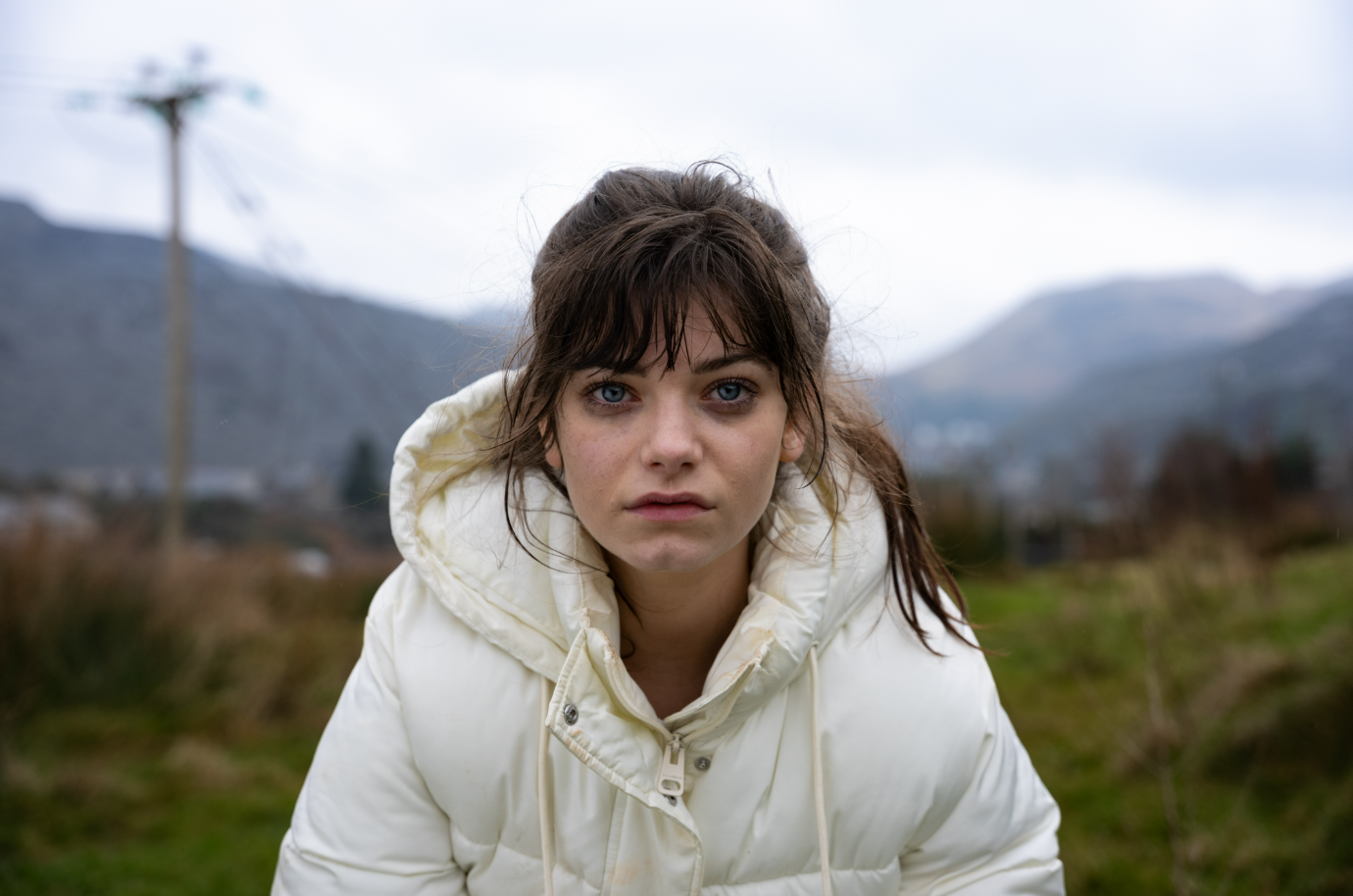
Based on Gary Owen’s award winning play, Iphigenia in Splott, the film transposes the action to rural North Wales. The film follows Effi (Leisa Gwenllian), a young woman who lives for the weekend. She has no one around her, bar a couple of friends, and her relationship with her gran (Carys Gwilym) is fractured, to say the least. A one night stand with former soldier, Lee (Tom Rhys Harries), upends her life. Upon discovering she is pregnant, she dares to dream of the solid family life she has clearly never had. However, Marc Evans’ film takes us on a starker route: one that exposes the crises of care, grief and loneliness.
The setting of the film underscores everything. Indeed, the title gives Effi roots in the North of Wales. The small town where she lives consists of a few grey, white and pastel houses speckled in amongst the rolling Welsh hills. The clouds hang low and even the overhead shots of farmland seem grey and tinged with sadness. Her estate, too, seems devoid of colour, with neighbours hurrying indoors to avoid making eye contact with her. This is contrasted with the new-build waterfront apartment that Lee takes her to; it gleams against the port side sun and suggests another life entirely.
There really aren’t enough superlatives to describe Leisa Gwenllian’s central performance. She takes the audience on such an incredibly moving emotional journey and holds your attention from the moment she first appears on screen. Nothing about Gwenllian’s Effi suggests peace or contentment, initially. She strides everywhere; her dialogue is delivered rapidly with a sharp edge. She’s a party girl whose only concern is where she’ll get money for her next quarter bottle of vodka. But, underneath her loud-mouthed bravado, there is a vulnerable and lonely young woman. Her one night stand with Lee – wherein he reveals he has a prosthetic leg – is marked by her ability to physically show care and understanding towards him. She is gentle and encouraging. “It shows we’re all so fragile and small. And so easily hurt,” she says, caressing his face.

As the film progresses, and Effi decides to move forward with her pregnancy, we get glimpses of joy from her. She feels excited to plan a future, a family, a life. She reconnects with her grandmother and swaps boozy Snapchats for videos of her baby’s heartbeat. It’s an entire rebuilding of who she is.
However, the early delivery of her baby plunges the film into a far more desperate, dark tone. The birth takes place in the back of an ambulance in the middle of a snow storm, with an external shot highlighting the futility of the blue flashing lights being swallowed up by the countryside and impassable roads. The location of the delivery, itself, highlights the pressures and shortages within the health system: Effi is initially left in an abandoned hospital ward before being bundled into the back of the ambulance alone. There is no one there to comfort her, hold her hand or reassure her. You can’t help but feel that this has been the story of her life: waves of unimaginable pain and no one there to support. Evans uses silence so powerfully, here, as Effi’s screams of labour are replaced with shots of the quiet hilltops and her grandmother’s empty kitchen. It’s a shocking turn of events that simply whips the hope out from under you and sets Effi on course for a new kind of personal destruction.
While the ending leaves Effi’s future unresolved, it carries a flicker of hope – less a promise of redemption than an insistence that her story matters. Gwenllian’s extraordinary performance anchors a film that is both intimate and politically charged, a portrait of a young woman failed by the systems meant to protect her yet still capable of profound tenderness. As a Welsh‑language production, it feels like a landmark: bold, compassionate and unafraid to confront the realities of rural life. A must watch.
Effi o Blaenau has its world premiere at the Glasgow Film Festival. Get your tickets here.

- Pressure – Review - September 12, 2026
- Backrooms – Review - May 31, 2026
- Obsession – Review - May 25, 2026