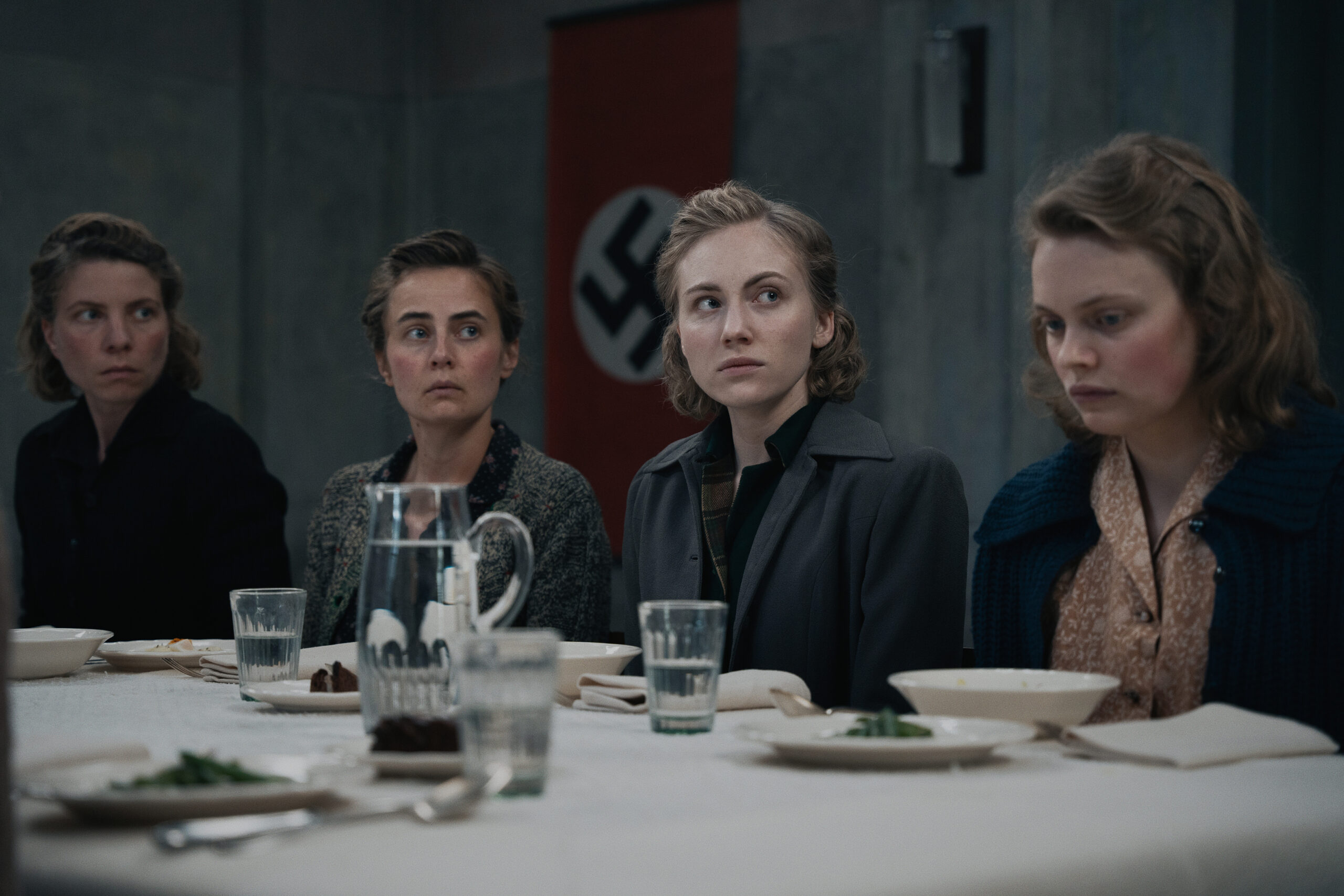
World War Two dramas rarely have women at their centre. Silvio Soldini’s The Tasters, however, explores the quiet acts of bravery and resilience that many young women undertook whilst war raged around them. Set from 1943 onwards, the film blends psychological tension, social critique and intimate character drama. Soldini’s direction is restrained but piercing, allowing the story’s unease to accumulate in small gestures, glances and silences. What emerges is a film that interrogates complicity, survival and the cost of being seen as expendable.
Based on the award-winning, bestselling book At the Wolf’s Table by Rosella Postorino, the film follows Rosa (Elisa Schlott), a young woman newly assigned to a tasting unit housed in a secluded compound. Her arrival disrupts the fragile equilibrium among the existing tasters, including the emotionally guarded yet perceptive Mira (Alma Hasun). Rosa’s outsider status is underscored immediately: she is nicknamed “Berliner” by the others, a label that marks her as both geographically and socially out of place. The nickname becomes a shorthand for suspicion, resentment and the group’s need to maintain psychological distance from anyone who might disrupt their current set up.
The narrative unfolds through the rhythms of the tasters’ daily routine – rounded up in an army vehicle, sterile meals, a heightened sense of supervision and, of course, the constant threat of poisoning. Interspersed in all of this are stories of husbands long lost to the Eastern front, those who are missing in action and those who refuse to believe that anything but victory is possible. Soldini and cinematographer Luca Bigazzi craft a visual world defined by muted austerity. The palette leans heavily on cold greys, washed‑out blues and institutional whites, creating an atmosphere that feels both clinical and oppressive. Occasional bursts of warm colour – sunlight on Rosa’s face, the earthy tones of the forest surrounding the compound – serve as fleeting reminders of a life beyond confinement and life without war. These contrasts subtly reinforce the film’s emotional arc: the tasters’ world is drained of vitality, yet traces of humanity persist.

The score, composed by Giovanni Venosta, is sparse but potent. Ominous strings underscore the omnipresent threat of contamination, while minimalist piano motifs accompany the characters’ moments of vulnerability. Venosta avoids melodrama, instead using sound to heighten the film’s psychological claustrophobia. Silence is deployed with equal precision; the absence of music during a particularly violent poisoning sequence makes the scene almost unbearable, as if the film itself is holding its breath.
Elisa Schlott anchors the film with a performance that is both raw and tightly controlled. Her Rosa is wary but not hardened, determined yet visibly fraying at the edges. Schlott excels at conveying internal conflict through micro‑expressions – small flickers of fear, defiance or longing that reveal the emotional toll of her environment. Her outsider status becomes the lens through which the audience experiences the compound’s unspoken rules and simmering tensions.
Max Riemelt brings a quietly threatening presence to Sonnerkommando Albert Ziegler. He rarely has to raise his voice – the mere click of his boots is enough to alter the mood of the group entirely. His desire for Rosa seems borne out of an attraction to her rebelliousness, contrasting neatly with his own urge to conform and “follow orders”. His brutal streak, not revealed until two thirds of the way through the film, is revealed with such casualness as to maximise shock impact. Alma Hasun delivers one of the film’s most layered performances as Elfriede. She embodies a woman who has built emotional armour out of necessity, yet whose empathy remains intact beneath the surface. Hasun’s scenes with Schlott are among the film’s strongest, capturing the delicate balance between solidarity and self‑preservation.

The ensemble surrounding the leads enriches the film’s sense of a closed, self‑regulating ecosystem. Each supporting character – whether a fellow taster, a guard or a chef – contributes to the oppressive atmosphere. No character feels extraneous; each one adds a thread to the film’s tapestry of quiet desperation.
The Tasters is a competently crafted drama that explores power, vulnerability and the human instinct for survival. It is a story about people trapped in a system who see them as expendable, yet who continue to assert their humanity in small but meaningful ways. It avoids melodrama to capture a moment in history perhaps isn’t seen as brave or as thrilling as frontline combat, but one that nonetheless required resilience and courage to survive.
The Tasters will be in UK cinemas from March 13.

- Pressure – Review - September 12, 2026
- Backrooms – Review - May 31, 2026
- Obsession – Review - May 25, 2026