Max Walker-Silverman’s Rebuilding is a gentle, quietly affecting drama that approaches loss in a way that feels rooted to the landscape it inhabits. Rather than leaning into the devastation of wildfire as a dramatic catalyst, the film opens in the soft aftermath of disaster, where the smoke has cleared but the emotional haze lingers. What emerges is a story about community, fractured families and the slow, uneven process of learning how to live again.
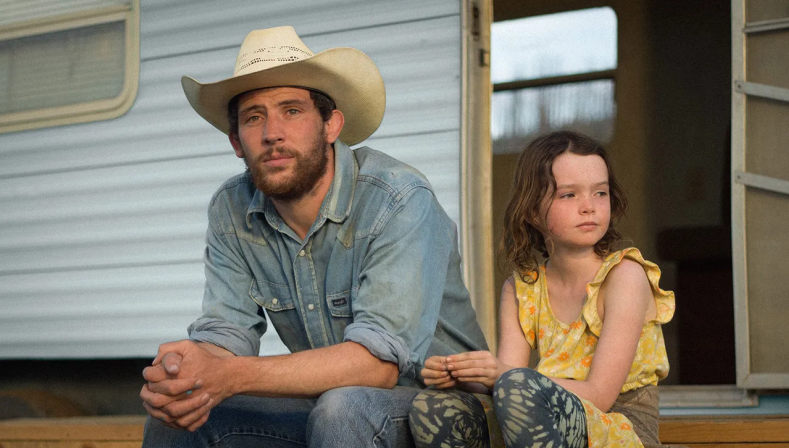
The film follows Dusty (Josh O’Connor), a cowboy whose family ranch has been destroyed in a wildfire. Displaced and emotionally adrift, he finds himself in a caravan park alongside others who have lost their homes. The camp becomes an unlikely crossroads: a place where grief is shared, routines are rebuilt and strangers become something like family. Dusty’s estranged daughter, Callie-Rose (Lily La Torre) and his ex-wife, Ruby (Meghann Fahy), re-enter his life, forcing him to confront the relationships he neglected long before the fire.
Josh O’Connor brings his characteristic sensitivity to Dusty, though the casting isn’t without its complications. O’Connor is a little too young and awkward to fully embody the world‑weary, taciturn cowboy the script imagines. His physicality and softness sometimes work against the archetype, making Dusty feel less like a seasoned rancher and more like someone still growing into the role. Yet this slight mismatch also lends the character a vulnerability that becomes unexpectedly compelling; Dusty’s hesitancy, his quiet discomfort, and his emotional inarticulacy all feel lived‑in, even if the cowboy persona doesn’t entirely fit.

Lily La Torre is excellent as Callie-Rose, grounding the film with a performance that is both naturalistic and emotionally precise. She avoids the precociousness that often plagues child roles, instead offering a portrait of a girl who is wary, wounded, but still hopeful. Her scenes with O’Connor are among the film’s strongest, capturing the tentative moments of a father and daughter relearning each other. Amy Madigan, though on screen only briefly, radiates a quiet resilience. Her presence deepens the film’s emotional landscape, reminding us that loss reverberates differently across generations.
The pacing is languid, but never in a way that drags. Walker-Silverman has a keen sense of when to linger and when to move on, allowing scenes to breathe without slipping into indulgence. The film’s gentleness is one of its greatest strengths: it knows exactly when to tug at the heartstrings and when to take a step back. Moments of silence are treated as meaningful, not empty, and the film’s emotional beats land precisely because they are never forced.
Visually, Rebuilding is stunning. As expected in a film so rooted in the American West, the landscape becomes a character in its own right. Sunsets bloom in flamingo pink and bruising violet; daytime scenes are washed in buttercream light. Yet the beauty is tinged with melancholy. The land, still arid and scarred from fire, appears sparse and incomplete. What should be lush ranchland is instead a patchwork of loss and uncertainty.

Costuming, particularly Dusty’s, mirrors this environment. His clothes are sun‑bleached, worn and muted, blending into the landscape as though he is both part of it and diminished by it. The visual cohesion between character and setting reinforces the film’s themes of identity, place and the struggle to rebuild. James Elkington and Jake Xerxes Fussell’s score twangs and hums as good country should.
At its heart, Rebuilding is a film about community, and the fragile but persistent hope that emerges after catastrophe. It explores how people reconstruct not just homes but relationships, routines and senses of self. The caravan park becomes a microcosm of collective healing: a place where strangers share food, stories and grief, and where Dusty learns that rebuilding is not a solitary act.
Rebuilding is a typical, quiet festival drama, asking its viewers to find beauty in landscapes marked by loss. Though not without imperfections, the visuals and the emotional stakes will keep you engaged. It is a story about devastation, yes, but more importantly about the small, stubborn acts of hope that allow green shoots to appear once more.
Rebuilding is screening at the Glasgow Film Festival. Get your tickets here.

- Pressure – Review - September 12, 2026
- Backrooms – Review - May 31, 2026
- Obsession – Review - May 25, 2026