Franz Kafka is one of the most celebrated writers of all time, spawning his own adjective to encompass all this surreal and nightmarish. His seminal works, including The Penal Colony, The Trial and The Metamorphosis are some of the most important and influential stories of the 20th century. Introverted, insecure and neurotic, the Czech writer was almost incapable of properly maintaining human relationships, instead preferring to pour his thoughts out on paper.
Agnieszka Holland’s biopic is a rather conventional one, woven together in an unconventional manner. With Idan Weiss playing the writer for the vast majority of the film, we get glimpses of his childhood via flashback whilst sinister shadows and kaleidoscope visions plague his mind. Interspersed with the story of his life as a middle-class, German speaking Jew in Prague are reimaginings of his works, tours of his museum and even trips to Kafka Burger, where an American-sounding guide swears you can eat just as the great author did.
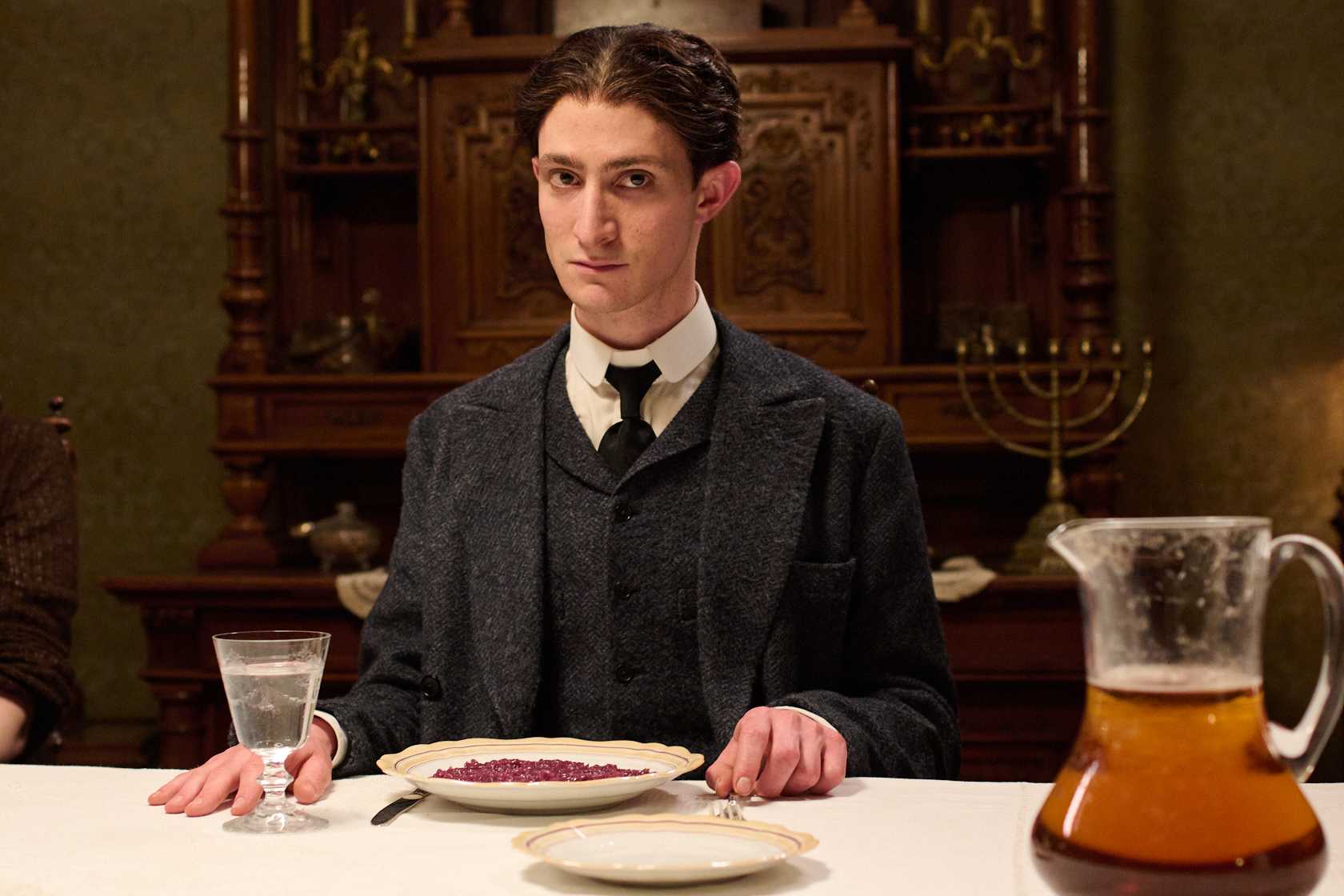
Weiss is, quite simply, mesmeric. His doe-like brown eyes gaze into the camera, as if begging the viewer to allow him to step outside his own troublesome mind. His scrawny frame and perfectly parted hair make for a sharp silhouette. Moreover, he captures the author’s mental health struggles in an empathetic manner. We see him wash his hands until they bleed; seek out all sorts of ‘alternative’ cures; boil over with paranoia and frustration. He is someone who becomes fascinated with a person or subject matter, only to quickly grow weary and keen to move on to the next thing. He is sensitive to both sound and language – a rough interaction with a starving beggar underlines just how thoroughly he places value on the words we use. Ultimately, we get the impression of a man not entirely interested in fame or money or romance. Indeed, he chooses to debate Kierkegaard in a brothel.

We get a strong sense of what shaped the great writer. His father, Hermann (played by Peter Kurth), is easily swayed to anger, his face puce and his mouth frothing with spit. “You have disappointed me often, soft boy. Once more makes no difference,” he snarls at his son. We also watch him violently crush a cockroach at family lunch, scraping the yellowy blob off the table with the flick of a knife. It’s no wonder Kafka’s Samsa felt so vulnerable and unloved. His mother and sister provide more understanding and emotional support whilst we explore Kafka’s complicated love life.
Holland also seems intent on exploring the tension between Kafka’s inner world and the rapidly shifting Europe around him. The film lingers on the cafés, cramped apartments and bureaucratic offices that shaped his imagination, drawing a clear line between the absurdity of his surroundings and the absurdity that would later define his fiction. There’s a quiet melancholy to the way Prague is shot, as though the city itself is complicit in Kafka’s anxieties. At times, the film even flirts with dark humour, particularly in its depiction of the literary circles and intellectual debates that both fascinated and exhausted him. These moments help ground the more expressionistic sequences, creating a portrait that feels both affectionate and unsparing.

The acclaimed director’s love of Kafka is clear. Her bruising reimagining of The Penal Colony makes for thoroughly captivating visuals as crimson blood spills across arid sand. She uses the Kafka museum to quite literally house Weiss’ performance, with gawking tourists pressing their noses up against frosted glass or peeping through tiny windows. Even the layout of the Kafka family home seems to mirror the description given in The Metamorphosis. Holland also uses documentary style talking heads to allow certain acquaintances and family members of the writer to directly address the camera, giving little asides or extra information as a particular event unfolds. It’s a neat little touch that gives the narrative a more intimate feel.
The film ends with Nazism sweeping through Prague and many of those in Franz’s life being rounded up and sent to camps. You can’t help but wonder how Kafka would have chosen to challenge the darkness of such a regime through the power of the written word. Or if he would have simply become one of many exterminated for his heritage.
Although Franz doesn’t necessarily add anything to the Kafka discourse – fans of the author are likely to be aware of his struggles – it is a nonetheless interesting film to watch, not least for Idan Weiss’ striking lead performance.
Franz screened at the Glasgow Film Festival.

- Pressure – Review - September 12, 2026
- Backrooms – Review - May 31, 2026
- Obsession – Review - May 25, 2026